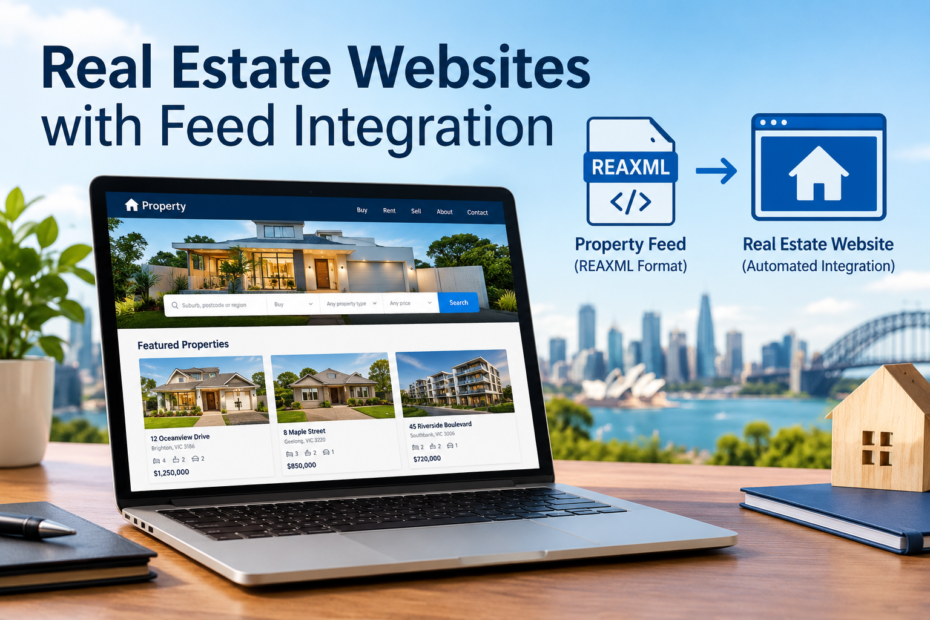
Real estate websites with feed integration have become essential tools for Australian property agencies, buyers, sellers, landlords, and investors. A well-designed website provides more than an online presence. It serves as a central platform for displaying property listings, generating enquiries, promoting agency services, and connecting prospective clients with relevant properties. For agencies managing dozens or hundreds of listings, keeping property information accurate across multiple platforms can be challenging without an effective integration process.
This is where real estate feed integration becomes particularly valuable. Instead of manually entering property information into a website every time a listing changes, agencies can use structured data feeds to transfer information from their existing property management or listing software to their websites.
In the Australian property industry, REAXML is an important format associated with exchanging real estate listing information between compatible systems. Understanding how REAXML works, what information it can carry, and how it supports website integration helps agencies make informed decisions when developing or upgrading their digital platforms.
A properly implemented integration can reduce repetitive administration, improve listing consistency, and help agencies maintain a more professional online presence. However, successful integration depends on more than simply importing a file. Website functionality, data validation, image handling, security, and ongoing maintenance all influence the final result.
Feed Integration – What Is REAXML?
REAXML is an XML-based format used to exchange real estate property listing information between software systems. XML, which stands for Extensible Markup Language, structures information using descriptive elements so that compatible applications can interpret individual data fields.
Within the Australian real estate sector, REAXML is commonly associated with transferring property listing information from agency systems to websites and property advertising platforms. The format provides a structured way to represent details such as property addresses, listing descriptions, property types, prices, inspection information, and associated images, depending on the feed specification and available data.
For example, an agency might maintain its property listings in a real estate CRM or listing management platform. When a property is created or updated in that system, the relevant information can be exported through a supported feed. A receiving website can then process the feed and display the listing without requiring staff to recreate every detail manually.
It is important to recognise that REAXML is a data exchange format, not a complete website platform or a property management system. It does not automatically provide a website design, search interface, enquiry management workflow, or content management functionality. Those features must be provided by the receiving website and its supporting software.
The precise information available also depends on the sending system, the feed configuration, and the implementation requirements. Agencies should confirm that the fields they need are supported before choosing an integration solution.
Why REAXML Matters in the Australian Property Market
Australia has a diverse real estate industry, with agencies operating across metropolitan, regional, and rural markets. Businesses may manage residential sales, residential rentals, commercial properties, land, new developments, or a combination of these categories.
Many agencies use specialised software to manage their listings and customer relationships. They may also advertise properties through third-party portals while maintaining their own websites. Without integration, the same property information can need to be entered and updated in several different places.
REAXML can help address this challenge by providing a structured method for transferring listing data between compatible systems. When the relevant software supports the format, an agency website can receive property information from its existing source rather than relying entirely on manual data entry.
This is particularly useful when prices change, properties go under contract, inspection times are updated, or new listings are added. An effective feed process helps ensure that changes made in the source system are reflected on the website after the next successful import.
However, REAXML does not guarantee that every connected platform will update instantaneously. The timing depends on how frequently feeds are generated, how often the receiving website checks for new data, and whether processing succeeds. Agencies should establish realistic expectations about update frequency and make sure important listing changes are handled appropriately.
How REAXML Feed Integration Works
A typical real estate website integration involves several stages, beginning with the system that holds the original property information.
First, the agency maintains its listings in a compatible real estate CRM, property management platform, or listing management application. That system provides the property details and, where configured, exports them in a supported REAXML feed.
Next, the feed is made available to the receiving website through an agreed delivery method. Depending on the implementation, this might involve a scheduled file transfer, a hosted feed location, or another supported mechanism. The exact arrangement varies between software providers.
The website then retrieves and parses the XML data. Its integration software identifies the relevant fields, validates the information, and maps the source data to the website’s internal property records.
After processing, the website creates new listings or updates existing ones. Property pages can display the information through predefined templates, while images and other media are associated with the appropriate records.
Finally, the system must handle changes and removals. When a property is sold, leased, withdrawn, or otherwise changes status, the receiving website needs a reliable process for reflecting that change. The appropriate behaviour depends on the source data and the agreed business rules.
Monitoring is an important part of the entire process. A feed that stops updating, contains invalid XML, or introduces inconsistent property identifiers can lead to outdated listings or incomplete pages. Good integration therefore includes logging, error reporting, and a way for the agency or developer to investigate failed imports.
Essential Features of a Property Website with Feed Integration
A website connected to a property feed should do more than display imported information. It should turn that information into a useful experience for visitors.
Property search is one of the most important features. Buyers and renters commonly want to filter listings by location, property type, price range, bedrooms, bathrooms, and other relevant characteristics. The available filters should reflect the information actually supplied by the feed and stored by the website.
Individual property pages should present the information clearly. Depending on the listing and available data, these pages may include photographs, descriptions, addresses or location details, pricing, property features, inspection information, and agency contact details.
Image management is another significant consideration. A feed may reference multiple images for a property, and the receiving system must associate them correctly. It should also handle missing images, image ordering, updated photographs, and changes to image references without leaving broken or unrelated media on the website.
Enquiry functionality allows visitors to contact the relevant agency about a property. Forms should capture the information the agency genuinely needs, identify the property being queried, and route enquiries to the correct destination. Agencies should also consider privacy obligations when collecting and storing personal information.
Mobile responsiveness matters because visitors increasingly expect to browse listings on phones and tablets as well as desktop computers. Search controls, image galleries, contact forms, and property details should remain easy to use across different screen sizes.
Finally, performance must be considered from the beginning. A website importing a large property portfolio can become slow if it repeatedly processes extensive XML files or loads every image at full resolution. Appropriate caching, image optimisation, database indexing, and efficient feed processing can help maintain responsive performance.
Managing Property Data Accurately
Reliable data management is central to successful REAXML integration. Even when a feed is valid XML, the information it contains may be incomplete, inconsistent, or unsuitable for direct display without additional processing.
Field mapping is one of the first challenges. The source system might provide a value in a format that differs from the website’s internal structure. For example, property types, listing statuses, price representations, or address components may require normalisation before they can be used consistently.
Australian addresses deserve particular attention. Street addresses, suburbs, states, and postcodes should be mapped accurately, while location-based search must account for the geographical information available in the source data. A website should not invent missing address details or assume that every property has precise geographic coordinates.
Price information also requires careful treatment. Some properties may display a fixed asking price, while others use a price range, an auction method, or an invitation to enquire. Rental listings may communicate rent differently from sales listings. The website should preserve the intended meaning rather than forcing every listing into an unsuitable format.
Duplicate detection is another important consideration. If a source system changes a property’s reference identifier or sends overlapping data, the website may accidentally create duplicate records. A robust implementation uses reliable identifiers and clearly defined rules for matching incoming listings to existing records.
Data validation should occur before changes become publicly visible. Depending on the implementation, checks can identify missing mandatory fields, malformed values, invalid image references, unexpected status changes, or other anomalies. Where appropriate, the system can reject problematic records, retain the last known valid information, and notify an administrator.
Feed Integration: Keeping Property Listings Updated Automatically
Automation is one of the main benefits of real estate feed integration. Once the process has been configured correctly, routine listing updates can occur without staff manually editing every property page.
The frequency of these updates should match the agency’s operational requirements. A website receiving a feed several times each day may be suitable for some agencies, while businesses with more frequent listing changes may require a different arrangement. The available options depend on the source software and the integration method.
Update processing should account for additions, modifications, and removals. New listings need to be created, existing records need to be refreshed, and properties that are no longer active must be handled according to the agency’s requirements.
Importantly, a missing property in a single feed should not automatically be interpreted as a confirmed removal unless the feed specification and delivery process establish that meaning. A temporary feed failure or incomplete export could otherwise cause active properties to disappear from the website. Safer implementations distinguish between confirmed removals and incomplete or unsuccessful imports.
Agencies should also decide how manually edited website content interacts with imported information. For example, an administrator might want to add a supplementary description or promotional text. If the next feed import overwrites that information, the website could lose content unexpectedly. A clear separation between source-controlled fields and website-managed fields helps prevent this problem.
Common Challenges with REAXML Integration
Although feed integration offers substantial practical benefits, implementation requires technical planning.
One common challenge is variation between providers. A website developer must understand the actual feed being supplied rather than assuming that every implementation contains identical fields or follows precisely the same operational rules. Documentation and sample feeds should be reviewed before development begins.
Large feeds can also create performance and reliability problems. Importing thousands of properties and associated image references in a single operation may place unnecessary pressure on the website. Scheduled background processing, incremental updates where supported, and sensible database design can improve efficiency.
Another challenge involves inconsistent or unexpected data. A listing may lack a description, contain an unusual price format, or reference media that is no longer available. The website should handle these cases gracefully rather than generating broken layouts or exposing raw technical errors to visitors.
Security should not be overlooked. Feed locations, file transfers, server permissions, and any associated credentials must be managed appropriately. Imported content should be treated as external input and validated before it is stored or displayed. XML processing should also be configured safely, including protection against dangerous external entity resolution and other avoidable parser vulnerabilities.
Finally, integrations require ongoing maintenance. Source software may change its feed configuration, website requirements may evolve, and new property fields may become necessary. Monitoring, testing, documentation, and a clear maintenance arrangement help keep the integration dependable over time.
Choosing the Right Website Development Approach
Australian real estate agencies have several options when planning a website with REAXML integration. The right approach depends on the agency’s size, technical requirements, budget, and existing software.
A customised website can provide greater control over design, property search, branding, and integration behaviour. It may suit agencies with specific workflows or complex requirements, although development and ongoing maintenance can involve greater costs.
A real estate website platform with existing feed support may offer a more straightforward implementation. Before selecting one, agencies should verify compatibility with their particular feed, the property fields supported, update frequency, image handling, and the process for dealing with sold or leased properties.
A content management system with a suitable integration component may provide another option. Its suitability depends on the quality of the integration, the expected listing volume, and whether the available functionality meets the agency’s needs without excessive customisation.
Regardless of the approach, agencies should ask practical questions before committing. Can the system process their actual REAXML feed? How are failed imports reported? How often are listings updated? Can the website handle multiple property categories? What happens when a listing is removed? Who is responsible for troubleshooting and maintenance?
Testing with representative data before launch is essential. The development team should verify new listings,